
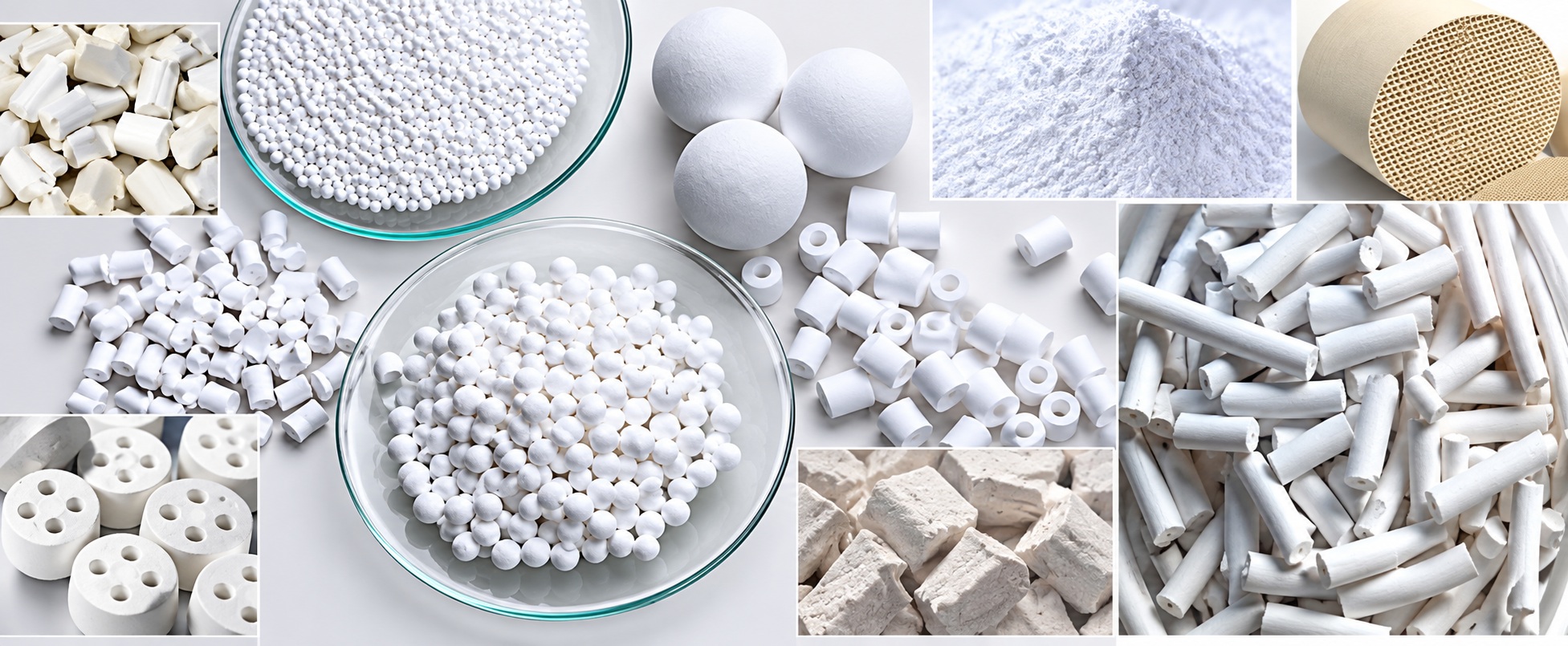
High surface area catalyst supports maximize the dispersion of active metal nanoparticles, exposing more active sites to reactants and greatly increasing catalytic activity. Large pore volume & High specific surface area support allows maximum dispersion of active metals (Ni, Co, Mo), pd, rh, ru, Ir providing more active sites for chemical reactions. Highly efficient at removing sulfur and nitrogen to meet strict environmental standards. The High mechanical strength Prevents the catalyst from crushing under high pressure and flow rates inside the fixed-bed reactor. The optimized bulk density and shape (like cloverleaf or trilobe profiles). This reduces the total weight of the catalyst needed to fill the reactor volume while maintaining a low-pressure drop and high void fraction. Because dispersion improves, manufacturers need a smaller total amount of expensive noble metals like Pt, Pd, Ir, Ru or Rh) to achieve the same or better performance. A stable, high-surface-area matrix keeps metal particles physically separated, preventing them from melting together or clumping (sintering) at high operating temperatures. The support is rarely completely inert; its surface chemistry, acidity, or electronic properties (such as Strong Metal-Support InteractionsI) can actively modify the electronic structure of the active metal which is important in reactions like Hydroisomerization where both cracking and hydrogenation is optimized. Tailored pore structures within high-surface supports allow smooth diffusion of reactants. The crystal form γ and δ Al2O3 are available.
| Sr No | Alumina Catalyst Carrier | Chemical Composition (%) | PV (ml/g) | BET (m2/g) | PS (Å) | D (g/ml) | Pellet Size (mm) | SO4 | |||
|---|---|---|---|---|---|---|---|---|---|---|---|
| SiO2 | FeO3 | Na2O | Width | Length | |||||||
| Alumina Catalyst Carrier (cylindrical) | |||||||||||
| ASC01 | Cylindrical | 0.02 | 0.02 | 0.1 | 0.8 | 280-300 | 12.7 | 0.60 | 1.5 | 2.5 | 0.3 |
| ASC02 | Cylindrical | 0.02 | 0.02 | 0.05 | 0.9 | 280-300 | 15.3 | 0.60 | 1.5 | 2.5 | 0.0 |
| Alumina Catalyst Carrier (Trilobe) 3N | |||||||||||
| ASC03 | Trilobe 3N | 0.01 | 0.007 | 0.07 | 0.8 | 280-300 | 12.7 | 0.62 | 1.5 | 2.5 | 0.4 |
| ASC03 | Trilobe 3N | 0.01 | 0.007 | 0.05 | 0.9 | 280-300 | 15.3 | 0.60 | 1.5 | 2.5 | 0.0 |
| Alumina Catalyst Carrier (Trilobe) 4N | |||||||||||
| ASC03 | Trilobe 4N | 0.01 | 0.007 | 0.07 | 0.8 | 280-300 | 12.7 | 0.62 | 1.5 | 2.5 | 0.0 |
| ASC03 | Trilobe 4N | 0.01 | 0.007 | 0.05 | 0.9 | 280-300 | 15.3 | 0.60 | 1.5 | 2.5 | 0.0 |
Our high-purity 3N and 4N alumina catalyst supports and carriers are engineered to deliver superior catalytic performance in refining, petrochemical, chemical processing, and environmental applications. Manufactured in optimized shapes such as trilobe, cloverleaf, cylindrical, and custom geometries, these materials combine high surface area, large pore volume, excellent mechanical strength, and controlled bulk density.
As catalyst supports, they provide an ideal platform for the dispersion of active metals including Ni, Co, Mo, Pt, Pd, Rh, Ru, and Ir. The high surface area and tailored pore structure maximize metal dispersion, increasing the number of accessible active sites and enhancing catalytic activity, selectivity, and metal utilization.
As catalyst carriers, they offer exceptional physical strength and thermal stability, ensuring reliable operation under severe process conditions. High crush strength prevents particle breakage in fixed-bed reactors, while optimized particle geometry provides low pressure drop, high void fraction, and efficient reactor utilization.
The large pore volume and interconnected pore network facilitate rapid diffusion of reactants and products, minimizing mass-transfer limitations and improving catalyst effectiveness. Enhanced metal dispersion also reduces the amount of expensive noble metals required to achieve target performance levels.
The high-surface-area alumina matrix helps prevent metal sintering by maintaining uniform dispersion of active species during prolonged high-temperature operation. In addition, the support surface can contribute to catalyst performance through acidity control and strong metal-support interactions (SMSI), particularly in hydroisomerization, hydrocracking, hydrogenation, and hydrotreating applications.
- High-purity 3N and 4N alumina grades
- High surface area and large pore volume
- Excellent active metal dispersion
- Reduced noble metal loading requirements
- High crush strength and attrition resistance
- Low pressure drop and high void fraction
- Enhanced sulfur and nitrogen removal performance
- Superior thermal and hydrothermal stability
- Available in trilobe, cloverleaf, cylindrical, ring, and custom shapes
- Suitable for hydrotreating, hydrocracking, hydroisomerization, hydrogenation, and environmental catalysts
Available Alumina Phases- γ-Al₂O₃ (Gamma Alumina), δ-Al₂O₃ (Delta Alumina), θ-Al₂O₃ (Theta Alumina), α-Al₂O₃ (Alpha Alumina)
These alumina supports and carriers can be tailored to achieve the required balance of surface area, pore structure, acidity, thermal stability, and mechanical strength for specific catalyst formulations and process requirements
Contact our team to discuss your requirements for high-purity 3N and 4N alumina catalyst supports and carriers, including shape, surface area, pore volume, mechanical strength, alumina phase, and customized specifications for your process requirements.